Tuesday, 17 May 2011

Early Pioneers: The Lumiere Brothers

Who are The Lumiere Bros?
Louis  and Auguste Lumiere were pioneer contributors to the birth of film in 1895. The Lumiere bros were born in France but then moved in 1870 to Lyon. Both of them attended the largest technical school in Lyon La Martiniere. Their father, Claude-Antoine Lumiere (1840-1911), ran a photographic firm and both brothers worked for him: Louis as a physicist and Auguste as a Manager. It wasn’t until their father retired in 1892 that the brothers began to create moving pictures. The Lumiere Bros were not the only ones to claim the title of the first cinematographers. The first scientific chronophotography devices developed by Eadweard Muybridge, Etienne-Jules Marey and Ottomar Anschutz in the 1880 were able to produce moving photographs, as was Thomas Edison’s Kinetoscope premiered in 1891.
What are the Lumiere Bros famous for?
The lumiere bros are well known by a lot of people for inventing the Cinematograph. The Lumieres held their first private screening of projected motion pictures in 1895. Thier first public screening of films at which admission was held on 28th December 1895, at the salon indien du Grand Cafe which is in Paris. This history-making presentation featured a short film, including their first film, sortie des Usines Lumiere a Lyon (Workers leaving the Lumier Factory).
What is Cinematography?
A cinematograph is a film camera, which also is a film projector and developer and it was invented in the 1890’s.There are many arguments to find its real inventor. People say that the device was first invented as “Cinematographe” by French inventor Leon Bouly on 12th February 1892. It is said, because theirs lack of money, Bouly was not able to pay the rent the following year, and the Lumiere bros engineers bought the license. Popular thought, however, Louis Lumiere was the first to convince the idea, and both Lumiere brothers shared the patent.
The Factors that affected the invention
The factors that effected the cinematograph camera was that it was very big and was very hard to carry around unlike the cameras today. The quality of the image wasn't that great either because it was only the start of the creation of fast moving image.
How this information has helped me
This information has helped me to understand The Lumiere bros and their followed on invention the cinematograph. The information that interests me the most is the first film ever made with the usage of Cinematography. I feel that it’s just unbelievable that the audience found that very short film amazing comparing to our technology today. Through my research I was able to earn about the Cinematograph and how you can create motion through this old camera. As the Lumiere Bros were inspired by the famous pioneer Eadweard Muybridge it makes me feel how the public in that time would have been feeling when these amazing inventions that have affected the world today. 


Earl Pioneer: Thomas Edison

Who is Thomas Edison?
Thomas Alva Edison did a lot of things in his time including an inventor, scientist and a businessman who developed many devices that had a massive impact on life around the world.
What is Thomas Edison Famous for?
Edison invented the Phonograph, the motion picture camera and a long-lasting practical electric light bulb. As we know today, the light bulb is probably one of the most needed electronics of all time. He was also the inventor of the Kinetoscope. This device was used in stop motion animation.
What is the Kinetoscope?
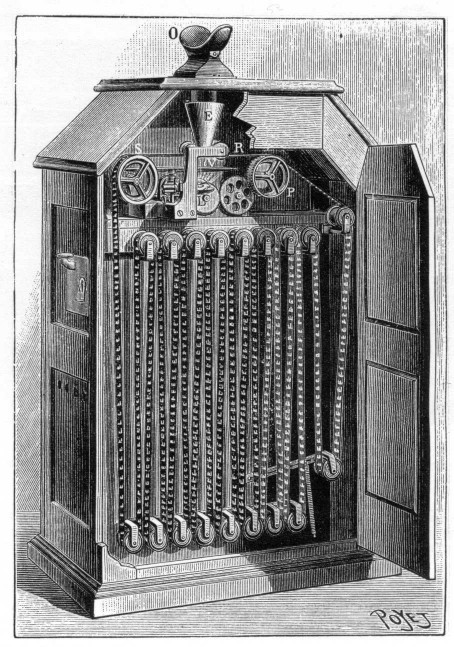
The Kinetoscope is an early motion picture device, but not a movie projector. It was designed for films to be viewed individually through the window of a cabinet containing its components. This invention was the basic introduction that would become the standard for all cinematic projection before video. Watching it creates the illusion of movement by conveying a strip of film bearing images over a light source with a high speed shutter.
Factors that affected it 
The factors that affected the kinetoscope was that only one person could view the invention at a time and the moving image shown only lasted about 5-10 seconds long. Another bad thing about the kinetoscope was that it was a huge box 4 foot long and there was a small peep hole at the top for people to see and the lighting wasn't that great when you looked into it as well.
How this information has helped me
This information has helped me to understand the basic knowledge of Thomas Edison. I have found out how the Kinetoscope works and how we create the illusion of moving image. The thing that inspired me the most about Edison is that he invented the light bulb and I feel that it is one of the most important inventions to this day.

Tuesday, 10 May 2011

Early Pioneer: Charles- Emile Reynaud

Who is Charles- Emile Reynaud?
Charles- Emile Reynaud was a French science teacher and projected the first animated cartoon films. Reynaud died in a hospice on the banks of the Seine where he had been cared for since 29 March 1917.
What is Charles- Emile Reynaud Famous for?
Reynaud is mostly known for creating a device called the Praxinoscope in 1877 and also created the Theatre Optique in December 1888, he presented this first animated film in public at the Musee Grevin in Paris.  In his later years, his inventions were slowly going to an end as the cinematograph camera was being brought in by The Lumiere Brothers. 
What is the Praxinoscope?
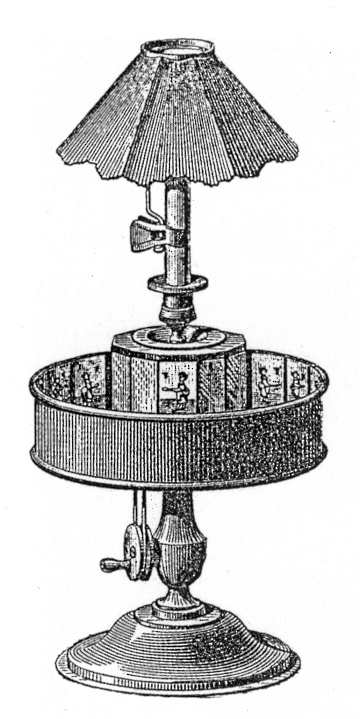
The Praxinoscope is very similar to the zoetrope (created by William Horner), it used a strip of pictures placed around the inner surface of a spinning cylinder. The Praxinoscope improved on the zoetrope by replacing its very narrow very slits with an inner circle of mirrors, placed so that the reflections of the pictures appeared more or less stationary in the positioned as the wheel was turned.  A viewer would look in the mirrors and then therefore sees a rapid succession of images producing the illusion of motion, with a brighter and less distorted picture than the zoetrope.

Factors that affected the Praxinoscope
The factors that affected the Praxinoscope is that if it was spun to fast it would look very blurry and you wouldn’t be able to see the moving image, also if you spun it backwards the sequence wouldn’t make sense.  
There weren’t just bad things about the Praxinoscope because it was the successor of the zoetrope. A zoetrope could only view the moving image to one person at a time, but now the Praxinoscope can be viewed multiple times by different viewers because it has mirrors all around it and you could see it at every angle.
How the information has helped me

I feel that I have learn't a lot from this research that I have found. I now understand how the praxinoscope works and what it consists off. The factors that effected the praxinoscope was very similar to the zoetrope and I feel that I now fully understand the key terms of this.

Tuesday, 11 January 2011

Early Pioneer: Joseph Plateau

Who is Joseph Plateau?

Joseph Antoine Ferdinand Plateau was a Belgian Physicist (a scientist who is trained in physics). Plateau attended the University of Liege where he went on as a doctor of physical and mathematical scientist in 1829. He did research about the human eye and how it works. He focused on the retina because it lets the eye see colour.
What is Joseph Plateau Famous for?

In 1832, Plateau and his sons introduced the Phenakistoscope which is a spindle viewer. It was also invented independently in the same year by Simon von Stampfer who called his invention a stroboscope. As a famous Pioneer, Plateau had inspirations from other inventor’s work from Michael Faraday and Peter Mark Roget. The invention consisted of two disks that spun in opposite directions from each other. At first it was a toy which was called the Faraday’s wheel until later he named it the Phenakistoscope.

  What is the Phenakistoscope?


The Phenikistoscope
The Phenakistoscope is uses the persistence of vision to create an illusion of motion. Although this theory had been recognized by the Greek mathematician Euclid, it wasn’t until 1829 that this principle became firmly established by Plateau. The Phenakistoscope used two discs mounted on the same axis. The first disc had slots around the edge, and the second had drawings of action, drawn around the disc in circles. Unlike Faraday’s wheel, whose pair of discs spun in opposite directions, a Phenakistoscope discs spun together in the same direction.  When viewed in a mirror through the disc’s slots, the pictures on the second disc will appear to move.


The Factors that affected the Phenakistoscope
The factors that affected the Phenakistoscope was that only one person could view at a time, if it was spun to fast the image would become blurry, if it was spun backwards you wouldn’t see a correct moving image, it was only a very basic animation like a couple waltzing and you would have to rely on a mirror. This technology was only popular for 2 years as new technologies were arising which were influenced by the Phenakistoscope but gave a superior result.

How has this information helped me?
This information has helped me to understand the key points of Joseph Plateau and how he and his sons created the Phenakistoscope. I feel that I understand in a clear way how the Phenakistoscope works and how it was made. This pioneer has made a massive impact towards moving image because if he and his sons didn’t make this way of moving image then we may not have developed film and animation the way we have today.

Tuesday, 4 January 2011

Early Pioneer: William George Horner

Who is William Horner?
William George Horner was a famous pioneer. He was a British Mathematician and published a mode of solving numerical equations of any degree now known as Horner’s degree. 
 
What is William Horner famous for?

The Zoetrope
William Horner invented the Zoetrope in 1834 and he originally called it a Daedalum (wheel of the Devil).  The Zoetrope was based on another pioneers invention which was Plateau's phenakistoscope. Horner's invention strangely became forgotten for nearly thirty years until 1867, when it became patented in England by M. Bradley, and in America by William F. Lincoln.  Lincoln renamed the Daedalum, giving it the name of zoetrope, or wheel of life.

How does the Zoetrope work?
The zoetrope uses the persistence of vision principle to create an illusion of motion.  It works from a simple drum with an open top, supported on a central axis.  A sequence of pictures on strips of paper are placed around the inner bottom of the drum.  Slots are cut at equal distances around the outer surface of the drum, just above where the picture strips were positioned.

To create an illusion of motion, the drum is spun; the faster the rate of spin, the smoother the progression of images.  A viewer can look through the wall of the zoetrope from any point around it, and see a rapid progression of images.  Because of its design, more than one person could use the zoetrope at the same time.  
What are the factors that affected the Zoetrope?
The main factors that affected the Zoetrope from working successfully is if the drum was spun too fast, the viewer would not be able to see the moving image because it would just look like a blur, If the drum was spun backwards, it would not work because it was only made to spin one direction and when spun backwards it would just look rubbish, the image that was shown only lasted about 5 seconds of moving image and the slits were quite hard to look through because they were very thin.
How this information has helped me

Through the whole of my research, this information has helped me to understand the basic Knowledge and understanding of William George Horner.  The information that interests me the most is that how he invented the zoetrope and how you can see a picture moving just through looking in a little slit. In modern days they still use this method of motion picture.